Resources
Learn the fundamentals of Waste heat to Power. Find out about current and emerging Waste Heat to Power Technologies, Policies, Industrial potential, and Market Sectors .
Credits:The Heat is Power Association
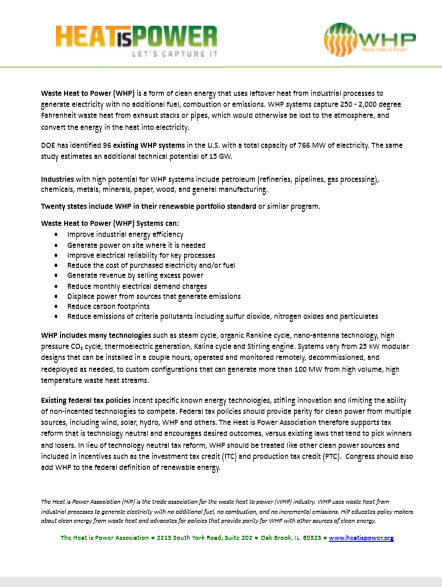
Waste Heat to Power Fact Sheet
Waste Heat to Power (WHP) is a form of clean energy that uses leftover heat from industrial processes to generate electricity with no additional fuel, combustion or emissions
WHP systems capture 250 – 2,000 degree Fahrenheit waste heat from exhaust stacks or pipes, which would otherwise be lost to the atmosphere, and convert the energy in the heat into electricity.
- Industries with high potential for WHP systems
- WHP Technologies
- Existing federal tax policies
Credits: Renewable thermal Collaborative
Low-Carbon Renewable Thermal Technology Solutions
Thermal energy, energy used for industrial processes and to heat and cool buildings, is a significant contributor to global energy demand and to greenhouse gas (GHG) emissions.
While policy solutions have been implemented for decades to expand the development of and access to renewable electricity, low-carbon renewable thermal technologies in particular, and low-carbon technologies for industry in general, have not benefitted from such widespread policy support.
- Importance of Reducing Thermal Energy Emissions
- The Current Policy Landscape
- Proposed U.S Federal Policies
- Recommendations
Low-Carbon Heat Solutions for Heavy Industry: Sources, Options, and Costs Today.
Heavy industry produces roughly 22 percent of global CO2 emissions. Of these, roughly 40 percent (about 10 percent of total emissions) is the direct consequence of
combustion.
To explore the topic of industrial heat decarbonization, the authors undertook an initial review of all options to supply high temperature, high flux, and high volume heat for a subset of major industrial applications: cement manufacturing, primary iron and steel production, methanol and ammonia synthesis, and glassmaking
- Hydrogen combustion
- electrolysis of water using renewable power
- Electrical heating
- Nuclear heat production
- Post-combustion carbon capture, use, and storage (CCUS) to industrial heat supply as basis for comparison
Credits: Combined Heat and Power Alliance
Combined Heat and Power Handbook
The global climate is changing, and many are working to reduce emissions and build up resiliency across sectors, including electricity generation, transportation, industry, and commercial and residential buildings.
This paper examines these key benefits of CHP systems and how CHP is a climate change solution because it can both
reduce emissions and be a resilient energy resource, reliably providing electric and thermal energy even during severe weather events. The next two pages highlight and summarize key insights found throughout the paper.
- How CHP Reduces Emissions
- CHP Provides Resilience in Response to a Changing Climate
- The State of the CHP Market
Kanin Energy News & Updates
Check out the Latest news and updates on Kanin Energy and the Waste Heat to Power Industry.

CERAWeek 2024: Decarbonization Through Waste Heat to Power
CERAWeek 2024 brought forth a lot of inspiring insights, and we were excited to be part of the conversations shaping our energy future. If you

Leveraging the Inflation Reduction Act: A Win for Waste Heat to Power Development
Last week’s signing of the Inflation Reduction Act (IRA) by President Biden marks a historic moment not just for the economy but also for the

Tallgrass, Kanin Energy to Develop Waste Heat to Power Projects
Waste heat for the projects will come off the back of compressor stations from Tallgrass’ Rockies Express
Pipeline—one of the largest natural gas pipelines in the U.S.